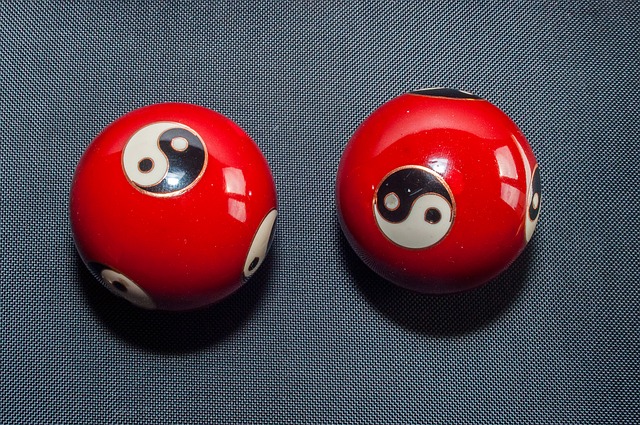
Yin & Yang by Bruce Lee

Bruce Lee
Oakland, California, USA

Taken from; “Chinese Gung Fu” The Philosophical Art of Self-Defense by Bruce Lee

The basic structure of Gung Fu is based on the theory of Yin/Yang, a pair of mutually complementary forces that act continuously, without cessation, in this universe. This Chinese way of life can be applied to anything, but here we are interested in its relationship to the art of Gung Fu. the black part of the circle is called Yin. Yin can represent anything in the universe as: negativeness, passiveness, gentleness, insubstantiality, femalness, moon, darkness, night, etc. The other complementary part of the circle is Yang, which represent positiveness, activeness, firmness, substantiality, maleness, sun, brightness, day, etc.
The common mistake most people make is to identify this Yin/Yang symbol, T’ai-Chi, as dualistic; that is Yang being the opposite of Yin, and vice versa. As long as we separate this “oneness” into two, we won’t achieve realization. Actually, all things have their complementary part; it is only in the human mind and his perception that they are being separated into opposites. The sun is not the opposite of the moon, as they complement and are interdependent on each other, and we cannot survive without either of them. In a similar way, a male is but the complement of the female; for without the male, how on earth do we know there is female, or vice versa. The “oneness” of Yin/Yang is necessary in life. If a persona riding a bicycle wishes to go somewhere, he cannot pump on both the pedals at the same time or not pumping on them at all. In order to move forward, he has to pump one pedal and release the other. So the movement of going forward requires this “oneness” of pumping and releasing. Pumping then is the result of releasing, and vice versa; each being the cause of the other.

In the Yin/Yang symbol there is a white spot on the black part, and black spot on the white one. This is to illustrate the balance in life, for nothing can survive long by going to either extremes, be it negativeness or positiveness. Therefore, firmness must be concealed in gentleness, and gentleness firmness, and that is why a Gung Fu man must be pliable as spring. Notice that the stiffest tree is most easily cracked, while the bamboo or will bend with the wind. So in Gung Fu, or any other system, one must be gentle yet not giving away completely; be firm yet not hard, and even if he is strong, he should guard it with softness and tenderness. For if there is no softness in firmness, he is not strong; in a similar way, if one has firmness concealed in softness, no one can break through his defense. This principle of moderation provides a best means of preserving oneself, for since we accept this existence of the oneness (Yin/Yang) in everything, and do not teat it dualistically, we thus secure a state of tranquility by remaining detached and not inclining to either extreme. Even if we do incline on one extreme, be it negative or positive, we will flow with it in order to control it. This flowing with it without clinging is the true way to get rid of it.

When the movements in Yin/Yang flow into extremes, reaction sets in. For when Yang goes to the extreme, it changes to Yin; and when Yin (activated by Yang) goes to the extreme, it returns back to Yang (that is why each one is the result and cause of the other.) For example, when one works to the extreme, he becomes tired and has to rest (from Yang to Yin). This incessant changing of Yin/Yang is always continuous.

The application of the theory of Yin/Yang in Gung fu is known as the Law of Harmony, in which one should be in harmony with, and not against the force of the opponent. Suppose A applies strength on B, B shouldn’t oppose or gives way completely to it. For these are but the two extreme opposites of B’s reaction. Instead, he should complete A’s force, with a lesser force, and lead him to the direction of his own movement. As the butcher preserves his knife by cutting along the bone and not against it, a Gung Fun man preserves himself by following the movement of his opponent without opposition or even striving (Wu-Wai, spontaneous, or spirit action). This spontaneous assisting or A’s movement as he aims it will result in his own defeat.

When a Gung fu man finally understood the theory of Yin/Yang, he no longer “fusses” with so-called “gentleness” or “firmness”; he simply does what the movement requires him to do. In fact, all conventional forms and techniques are all gone, his movements are those of everyday movements. He doesn’t have to “justify” himself like so many other masters have, claiming his spirit or his internal power; to him, cultivation of martial art in the long run will return to simplicity, and only people of half-way cultivation justify and brag about themselves.


16 Motivational Life Lessons From Bruce Lee

Published by LifeHack.org

Contents

Why Listen To Bruce Lee’s Life Lessons?

If you’re a martial artist, then it’s pretty obvious that Bruce Lee is a person that is worth modeling. The level to which he developed both his body and his mind in the pursuit of martial arts was simply incredible.

However, it’s often overlooked just how much he accomplished in his short life. He constantly battled against racial stereotypes in developing his movie career, and his success in this area lead him to be regarded as one of the most influential martial artists of our time. He started out with huge goals in life and achieved so much that he definitely has some motivational life lessons we can learn from.

Lesson #1 – Life Purpose

“The key to immortality is first living a life worth remembering.”

You only have one life in this body so make the most of it by creating something that adds value to those around you.

Lesson #2 – Limits

“If you always put limit on everything you do, physical or anything else. It will spread into your work and into your life. There are no limits. There are only plateaus, and you must not stay there, you must go beyond them.”

“Ever since I was a child I have had this instinctive urge for expansion and growth. To me, the function and duty of a quality human being is the sincere and honest development of one’s potential.”

You will only grow to the limits that you place on yourself (and let others place on you). To truly reach your potential you must forget limits and realize you will never reach your full potential in this lifetime.

Lesson #3 – Happiness

“Be happy, but never satisfied.”

Allow yourself to be happy now and don’t wait until you’ve reached some arbitrary goal. However, remember that everything in life is either growing or dying, so choose which one you prefer for your life.

Lesson #4 – Self Image

“I’m not in this world to live up to your expectations and you’re not in this world to live up to mine.”

“As you think, so shall you become.”

You define yourself–no one else. So when you create an incredible self image for yourself you will naturally grow into your own amazing expectations.

Lesson #5 – Goals

“A goal is not always meant to be reached, it often serves simply as something to aim at.”

Any goal can be reached when given enough time. So let go and just start moving in the right direction.

Lesson #6 – Learning

“Use only that which works, and take it from any place you can find it.”

“A wise man can learn more from a foolish question than a fool can learn from a wise answer.”

“Take no thought of who is right or wrong or who is better than. Be not for or against.”

Always be open to the lessons around you no matter where they come from. Everything in life can teach you something if you are open to receiving the lesson.

Lesson #7 – Action

“Knowing is not enough, we must apply. Willing is not enough, we must do.”

“If you spend too much time thinking about a thing, you’ll never get it done.”

“Knowledge will give you power, but character respect.”

There are plenty of people in this world who know what they have to do to get what they want. The few that succeed are those who develop a character of constant and deliberate action.

Lesson #8 – Focus

“I fear not the man who has practiced 10,000 kicks once, but I fear the man who has practiced one kick 10,000 times.”

There are many paths you can follow to reach your destination. However, you’ll never reach the end if you keep changing paths along the way.

Lesson #9 – Time

“If you love life, don’t waste time, for time is what life is made up of.”

We all start each day with 24 hours in the bank; the difference is what we do with it.

Lesson #10 – Failure

“Don’t fear failure. — Not failure, but low aim, is the crime. In great attempts it is glorious even to fail.”

Failure is a natural part of the learning process for anything we do. No parent has ever watched their child fall while trying to take their first steps and said, “well, I guess they’re not a walker.” So why would you do this to yourself?

Lesson #11 – Perseverance

“Do not pray for an easy life, pray for the strength to endure a difficult one.”

You are always going to have problems and challenges in your life. Success in any area is simply learning how to overcome bigger and bigger challenges.

Lesson #12 – Flexibility And Adaptability

“Be like water making its way through cracks. Do not be assertive, but adjust to the object, and you shall find a way around or through it. If nothing within you stays rigid, outward things will disclose themselves.

Empty your mind, be formless. Shapeless, like water. If you put water into a cup, it becomes the cup. You put water into a bottle and it becomes the bottle. You put it in a teapot, it becomes the teapot. Now, water can flow or it can crash. Be water, my friend.”

Become flexible and adaptable in your daily life and problems will roll off your shoulders. Tension is only created when results do not met our expectations or perception of how the world should be.

Lesson #13 – Simplification

“It’s not the daily increase but daily decrease. Hack away at the unessential.”

“Adapt what is useful, reject what is useless, and add what is specifically your own.”

When you clear your life and mind of the unessential then amazing things start to happen. Be ruthless in asking, “does this serve my greater life purpose?”

Lesson #14 – Relationships

“To know oneself is to study oneself in action with another person.”

Let go of the behaviors and actions of others as you can never change someone else. Instead look at how you interact (and react) with others, as this is a reflection of your own beliefs.

Lesson #15 – Service

“Real living is living for others.”

Realize that anything you want in life can be obtained by helping others get what they want.

Lesson #16 – Live In The Moment

“Take things as they are. Punch when you have to punch. Kick when you have to kick.”

Always focus your attention on the present moment. Your past does not determine your future–that comes from what you do in this exact moment.

What You Do Next

I hope you enjoyed these 16 motivational life lessons from Bruce Lee. However it’s important to remember that they do little unless you apply them to your life. So pick the lesson above that will create the most impact for you personally right now, and take action on it.

That’s what I call Martial Mind Power!

10 More Life Lessons From Bruce Lee

Published by Sources Of Insight


Sure you know Bruce Lee the martial artist and movie star.

But do you know Bruce Lee the philosopher, comedian or master of personal development?

Bruce was one of my early inspirations.

He continuously pushed his mind and body to new levels and his physical prowess inspired and influenced body builders and martial artists alike.

As far as heroes go, Bruce Lee truly set an example of what it means to be YOUR best.

Bruce was all about making the most of what you’ve got, seeking truth knowledge, and applying what you know.

If you’ve seen him in movies or you know some of his quotes, you know exactly what I mean.

Contents

10 Lessons Learned from Bruce Lee

In this post, I share my lessons from Bruce Lee.
These are my top 10 lessons from Bruce Lee:

1. Be YOUR best.

It’s not about following in someone else’s footsteps or trying to be somebody you’re not.  It’s about unleashing your best version of yourself.  According to Bruce, “Always be yourself, express yourself, have faith in yourself, do not go out and look for a successful personality and duplicate it.”

2. Absorb what is useful.

It’s not about blindly adopting patterns and practices.  It’s about taking the best of the best and tailoring it.  It’s also about throwing away what doesn’t work.  Bruce borrowed concepts and techniques from everybody and every art in a relentless pursuit of the best of the best.  According to Bruce, “Absorb what is useful, Discard what is not, Add what is uniquely your own.”

3. Keep an open mind.

You have to be willing to throw out what you already know and have a curiosity to explore new paths.  If you’re cup is already full, you can’t learn new things.  According to Bruce, “First empty your cup.”

4. Aim past your target.

Aim past your target, so when you fall short, you still land in the ballpark of success.  Bruce Lee was famous for his one-inch punch, but in reality he was aiming past the one-inch.  According to Bruce, “Don’t fear failure.  Not failure, but low aim, is the crime. In great attempts it is glorious even to fail.”

5. Stay flexible.

Be flexible in your approach.  Learn from everybody and everything and don’t get locked into a particular style.  According to Bruce, “Expose yourself to various conditions and learn.”

6. Focus on growth.

Push past your limits.  According to Bruce, “There are no limits. There are only plateaus, and you must not stay there, you must go beyond them.”

7. Know yourself.

Your blind spots and ignorance can be your biggest weakness.  According to Bruce, “After all, all knowledge simply means self-knowledge.”

8. Master your mind and body.

It’s not enough just to be smart.  It’s not enough just to master your body.  Your body and mind support each other.  Your body helps turn what you think or dream up into results.  According to Bruce, “As you think, so shall you become.”

9. Apply what you know.

Life is not about watching from the sidelines.  Use what you know and put knowledge into practice.  Test yourself.  According to Bruce, “Knowing is not enough, we must do.  Willing is not enough, we must apply.”

10. Make things happen.

When there is no wave, make one.  According to Bruce, “To hell with circumstances; I create opportunities.”

I think it really boils down to making the most of what you’ve got, including your mind and body, pushing past your limits and following a path of continuous learning and growth.P

“Then Die,” Said Bruce Lee

Written by Bruce Lee in The Art of Expressing The Human Body


From the Art of Expressing The Human Body, there’s this little story about Bruce Lee, arguably the greatest martial artist that ever lived, during a training run told by John Little, a close friend of Bruce’s.


“Bruce had me up to three miles a day, really at a good pace. We’d run the three miles in twenty-one or twenty-two minutes. Just under eight minutes a mile [Note: when running on his own in 1968, Lee would get his time down to six-and-a half minutes per mile]. So this morning he said to me “We’re going to go five.” I said, “Bruce, I can’t go five. I’m a helluva lot older than you are, and I can’t do five.” He said, “When we get to three, we’ll shift gears and it’s only two more and you’ll do it.” I said “Okay, hell, I’ll go for it.” So we get to three, we go into the fourth mile and I’m okay for three or four minutes, and then I really begin to give out. I’m tired, my heart’s pounding, I can’t go any more and so I say to him, “Bruce if I run any more,” –and we’re still running-”if I run any more I’m liable to have a heart attack and die.” He said, “Then die.” It made me so mad that I went the full five miles. Afterward I went to the shower and then I wanted to talk to him about it. I said, you know, “Why did you say that?” He said, “Because you might as well be dead. Seriously, if you always put limits on what you can do, physical or anything else, it’ll spread over into the rest of your life. It’ll spread into your work, into your morality, into your entire being. There are no limits. There are plateaus, but you must not stay there, you must go beyond them. If it kills you, it kills you. A man must constantly exceed his level.”


Either push your limits or die. If you’re going to allow yourself to be bound by arbitrary, artificial and anonymous limits, why even bother? One more time (you know you should read it). If you stop at your “limits”…


“…you might as well be dead. Seriously, if you always put limits on what you can do, physical or anything else, it’ll spread over into the rest of your life. It’ll spread into your work, into your morality, into your entire being. There are no limits. There are plateaus, but you must not stay there, you must go beyond them. If it kills you, it kills you. A man must constantly exceed his level.”


What’s your level? Are you exceeding it or are you dying? Because if you let limits define what’s possible in your life, you’re not growing, you’re dying.


To break-through your mental and physical barriers, come train with JKD London or attend a Martial Mind Power workshop now


Peace & Respect,

Lak Loi

Be Like Water My Friend

Water is a great teacher that shows us how to move through the world with grace, ease, determination, and humility.

The journey of water as it flows upon the earth can be a mirror of our own paths through life. Water begins its residence on earth as it falls from the sky or melts from ice and streams down a mountain into a tributary or stream. In the same way, we come into the world and begin our lives on earth. Like a river that flows within the confines of its banks, we are born with certain defining characteristics that govern our identity. We are born in a specific time and place, within a specific family, and with certain gifts and challenges. Within these parameters, we move through life, encountering many twists, turns, and obstacles along the way just as a river flows.

Water is a great teacher that shows us how to move through the world with grace, ease, determination, and humility. When a river breaks at a waterfall, it gains energy and moves on, as we encounter our own waterfalls, we may fall hard but we always keep moving on. Water can inspire us to not become rigid with fear or cling to what’s familiar. Water is brave and does not waste time clinging to its past, but flows onward without looking back. At the same time, when there is a hole to be filled, water does not run away from it in fear of the dark; instead, water humbly and bravely fills the empty space. In the same way, we can face the dark moments of our life rather than run away from them.

Eventually, a river will empty into the sea. Water does not hold back from joining with a larger body, nor does it fear a loss of identity or control. It gracefully and humbly tumbles into the vastness by contributing its energy and merging without resistance. Each time we move beyond our individual egos to become part of something bigger, we can try our best to follow the lead of the river.

>